
Heartburn – Symptoms, Causes & Herbal Treatment
Heartburn is an uncomfortable, burning sensation in the chest area that is often accompanied by a sour taste in the mouth.
Almost everyone has experienced it at some point, but did you know that it regularly affects up to 40% of the population in Western countries?
In this article, we want to take a look at the various causes and highlight different conventional, as well as alternative and herbal treatment options for relief.

The Symptom of Heartburn
Heartburn is a common problem caused by acid reflux and is a frequent symptom of dyspepsia. The discomfort can vary from person to person, but it usually occurs in the chest area and can radiate up to the throat.
The most common symptoms are a burning sensation in the chest and a sour taste in the mouth[1]. These usually occur after eating or while lying down and can be triggered by certain foods. Other accompanying symptoms also include abdominal pain, nausea, belching, and a feeling of fullness. Some people also experience a tightness in the chest, which can often be mistaken for angina pectoris.
When should you see a doctor?
In most cases, the symptoms are no cause for concern and can be treated with simple lifestyle changes and over-the-counter medications. However, there are certain circumstances under which a medical evaluation is necessary. If heartburn occurs more frequently, increases in intensity, lasts longer than 2 weeks, or is accompanied by other symptoms such as difficulty swallowing, vomiting, or weight loss, a doctor should be consulted. Additionally, people who are older than 50 or have a history of stomach ulcers or reflux disease should see a doctor to ensure that the symptoms are not due to a more serious condition.
Common Causes of Heartburn
When the esophagus hurts
To understand the causes, it is helpful to know the structure of the stomach and the esophagus. The stomach is a muscular organ that digests food and passes it on to the small intestine. The lower part of the esophagus opens into the stomach and is controlled by the lower esophageal sphincter. This is a muscular ring that opens to let food into the stomach and then closes to keep the acidic contents of the stomach there.
How does heartburn develop?
Heartburn occurs when the acidic stomach contents flow back into the esophagus (reflux) and hit the sensitive mucous membranes there. This can happen if the esophageal sphincter does not close properly or is too weak. The acid reflux then causes a burning sensation and pain extending into the chest area.
Anger, stress, and anxiety
Emotional distress, anger, stress, and anxiety can also lead to the production of too much stomach acid and cause heartburn. When we are stressed or anxious, our bodies produce more hormones like adrenaline, which can impair digestion. This can literally “leave a sour taste in one’s mouth.”

Risk factor: Obesity
Obesity can be a significant risk factor for these symptoms. The extra weight can increase pressure on the stomach and weaken the esophageal sphincter, which can lead to an increased risk of acid reflux. Various studies have observed that people with a body mass index (BMI) of over 30 have an increased risk of heartburn.
Reflux disease
In some cases, it can also be a symptom of gastroesophageal reflux disease (GERD). GERD is a chronic condition characterized by acid reflux and inflammation in the esophagus. Symptoms can include heartburn, acid regurgitation, nausea, and difficulty swallowing. People who frequently suffer from heartburn should see their doctor for a correct diagnosis and treatment.
Heartburn During Pregnancy
Pregnancy reflux (heartburn during pregnancy) is a common set of symptoms. The hormonal changes and physiological adaptations during pregnancy, such as the growing uterus pressing on the stomach, can cause stomach acid to flow back into the esophagus more easily.
What you can do about heartburn
Treatment can vary depending on the severity and cause of the symptom. In general, a combination of lifestyle changes, medication, and in some cases even surgical intervention may be necessary to effectively treat heartburn.
Lifestyle changes as a treatment for heartburn
Lifestyle changes are often the first step in treating heartburn. This includes changing your diet and minimizing weight if you are overweight. Avoid fatty and acidic foods, alcohol, and caffeine, which can lead to acid reflux. Eat smaller meals and avoid eating directly before bedtime to give the stomach time to digest. We have compiled some helpful everyday tips that you can implement to relieve heartburn.
Smoking
Smoking with heartburn can worsen symptoms by weakening the esophageal sphincter and irritating the mucous membranes. Quitting smoking can therefore also help reduce the symptoms.

Medications for the treatment of heartburn
If lifestyle changes or home remedies are not enough, medications can be used to treat heartburn. Antacids neutralize stomach acid and thus relieve symptoms. Histamine-2 receptor blockers reduce the amount of acid produced in the stomach.
Proton pump inhibitors (PPIs), commonly referred to as acid blockers, are prescribed for heartburn when the condition is severe or chronic. PPIs are often used over a longer period and should only be taken under medical supervision.


Herbal treatment: Juniper oil for heartburn?
Juniper oil can help with heartburn due to its anti-inflammatory and antispasmodic effects[2]. It can reduce inflammation in the digestive tract and relax the gastrointestinal muscles, which can reduce acid production in the stomach and decrease the reflux of stomach acid into the esophagus. Juniper oil can be taken in capsule form as a medicinal product.
Another important effect of juniper oil is its ability to exert an anti-inflammatory effect[3] on the intestinal mucosa. This can help reduce symptoms caused by inflammation. You can learn more about juniper and heartburn here.

Studies on juniper oil for heartburn
Two clinical studies have shown that D-limonene (a main component of juniper berry oil) effectively relieves the symptoms of occasional heartburn and GERD[4]. An in vitro study suggests that the juniper berry oil component D-limonene exerts a neutralizing effect on stomach acid by coating the stomach lining and protecting it from gastric juice[5]. Furthermore, the anti-inflammatory effect of juniper berry oil can help reduce inflammation in the esophagus caused by repeated contact with stomach acid[6].

What Roleca Juniper can do for your well-being:
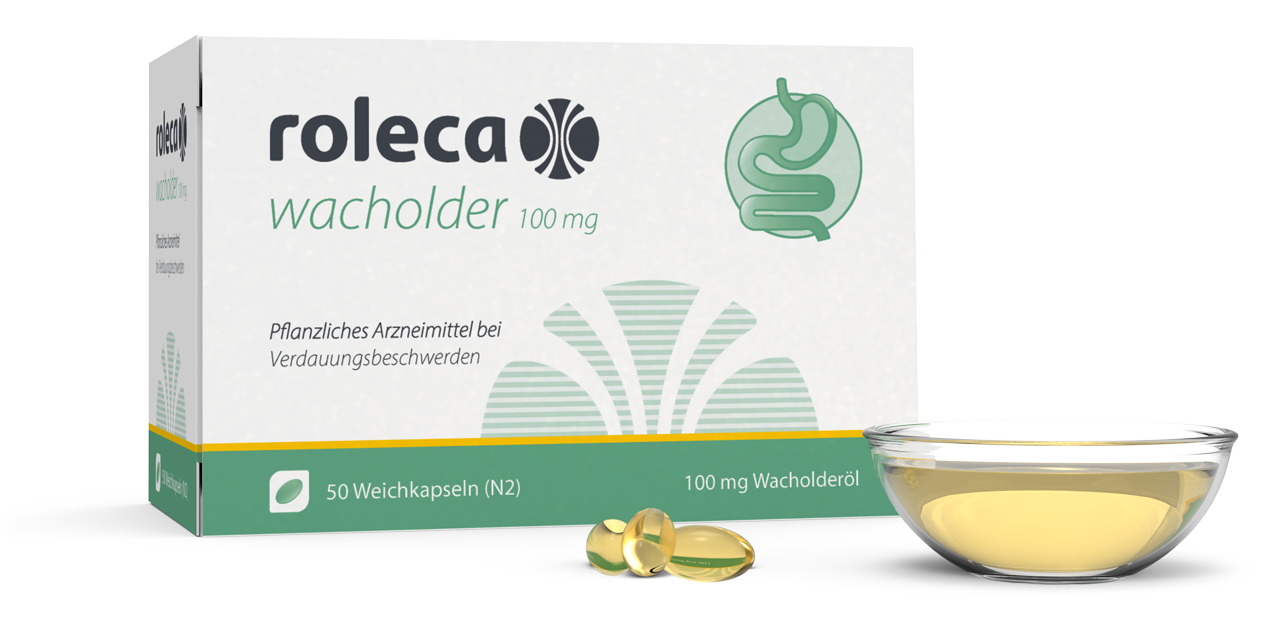
We at Roleca Pharma also utilize the healing power of juniper berries[7]. As the only juniper oil medicinal product in Germany, we have specifically developed Roleca Juniper to relieve discomfort in the gastrointestinal tract.
This is a purely herbal product that is effective with a dosage of just one capsule per day. The medicine can be taken for both acute and chronic abdominal pain. Especially because of its antispasmodic effect, Roleca Juniper is recommended for abdominal cramps, heartburn, and a feeling of fullness.
Find out more about Roleca® Juniper here.
You can order Roleca® products directly online here!
Juniper oil for
digestive complaints
Bibliography
- Clarrett, Danisa M., and Christine Hachem. “Gastroesophageal reflux disease (GERD).” Missouri medicine 115.3 (2018): 214
https://www.ncbi.nlm.nih.gov/pmc/articles/PMC6140167/pdf/ms115_p0214.pdf - Majewska, Ewa, et al. “Characterization of the essential oil from cone-berries of Juniperus communis L.(Cupressaceae).” Herba Polonica 63.3 (2017): 48-55
https://agro.icm.edu.pl/agro/element/bwmeta1.element.agro-a4d43d9a-08bc-4cde-a83e-bb21c6366188/c/5.pdf - Raina, Rajinder, et al. “Potential of Juniperus communis L as a nutraceutical in human and veterinary medicine.” Heliyon 5.8 (2019)
https://doi.org/10.1016/j.heliyon.2019.e02376 - Sun, J., 2007. D-Limonene: safety and clinical applications. Altern Med Rev 12, 259–264
https://pubmed.ncbi.nlm.nih.gov/18072821/ - Wilkins J Jr. Method for treating gastrointestinal disorder. U.S. Patent (642045). 2002. US6420435B1
- Pramanik, K., Biswas, R., Bandyopadhyay, D., Mishra, M., Ghosh, C., Chatterjee, T., 2007. Evaluation of Anti-Ulcer Properties of the Leaf Extract of Juniperus communis L. in Animals. Journal of Natural Remedies 7, 207–213
https://doi.org/10.18311/jnr/2007/310 - Gonçalves, Ana C., et al. “Zimbro (Juniperus communis L.) as a promising source of bioactive compounds and biomedical activities: A review on recent trends.” International Journal of Molecular Sciences 23.6 (2022): 3197′
https://doi.org/10.3390/ijms23063197
Learn more about the following topics



This post is also available in:
Kontakt

Roleca Pharma GmbH
Georgstraße 38
D-30159 Hannover
T: +49 511 5151 680
info@roleca.com
Melden Sie sich zu unserem Newsletter an, um auf dem Laufenden zu bleiben

