
Stimulate Digestion
Are you among those who suffer from a sluggish bowel? If you have digestive problems, you are definitely not the only one! Many people suffer from digestive complaints that prevent them from enjoying life carefree. Whether bloating, abdominal cramps, or other abdominal pain: almost everyone has experienced such symptoms.
Often, the causes lie in our own behavior: a stressful lifestyle combined with fast food, convenience products, and too little time for rest and relaxation1. Does this sound familiar? Read our expert digestion tips and support your digestion naturally and long-term.

Now it’s your turn: Nothing beats teamwork
If you want to help your body, you must first understand it better. Our digestive system is responsible for much more than just digesting the food we eat. The gastrointestinal tract is equipped with a vast nervous system, containing more than 100 million nerve cells and about 80 percent of our immune cells. The neurotransmitter serotonin is produced in the gut. Serotonin is much more than a happiness hormone; it is an important messenger substance. It helps our body reduce or completely prevent bacterial infections.

The Second Brain – The Gut Brain
The so-called gut brain2 not only coordinates digestion or decides what the body should absorb and what should be excreted: a close communication system exists between the gut and the head via the gut-brain axis. We can make certain decisions “from the gut.” Something “gets to our stomach.” If our digestion doesn’t function properly, it can affect our mood. Medical research increasingly shows that our gut bacteria have a significant influence on our psychological well-being and mental balance. If you want to sustainably strengthen your immune system and your health, you should keep your gut healthy and stimulate your digestion, as these are the most essential factors for our overall well-being. You can read more here about the function of healthy digestion.

A Normal Bowel Day Lasts at Least 24 Hours
Typically, it takes at least 24 hours for a meal to pass from the mouth through the digestive tract to excretion. This so-called “transit time” depends on many factors. Among the most important are undoubtedly the type of diet, the extent of daily physical activity, and psychological stress we are exposed to.
After the Third Day, It’s Bowel Sluggishness
If what is to be excreted by the body via the bowel does not leave it for more than three days, we speak of bowel sluggishness. In addition to restricting personal well-being, a sluggish bowel also poses a long-term health risk. To stimulate slow digestion, it is first important to question which habits have led to bowel sluggishness in the first place.

The Causes of Slow Digestion
The most common reasons for a sluggish bowel, besides a low-fiber, fatty diet, are a lack of fluids and exercise. In addition, certain diseases and the intake of medication can also be responsible for slow digestion.
Even if our bodies react differently to the same nutrients, there is ultimately no universally valid answer to the question of what can cause slow digestion.
Nevertheless, it is agreed that ready meals, fast food, and snacks are foods that contain too much sugar, salt, artificial additives, and saturated fats. They are harder to digest because they tend to slow down metabolism rather than stimulate it. Furthermore, they contain hardly any nutrients, especially fiber, which is needed for healthy digestion. In addition, the high salt content in many foods can dehydrate the digestive tract, which in turn promotes constipation.

Home Remedies and Tips to Stimulate Digestion
However, there is a clear answer to the question of which nutrients can stimulate digestion: fiber! In addition, a fiber-rich diet brings you further health benefits, such as lowering your cholesterol level and reducing the risk of heart disease.
Why Does Fiber Stimulate Digestion?
Fiber consists largely of indigestible food components found in plant-based foods such as fruits, vegetables, legumes, nuts, and whole grains. By absorbing fluid like a sponge, significantly increasing stool volume, and making it softer, they ensure faster and healthier digestion.
Therefore, in addition to carbohydrates, protein, and high-quality fats, fiber should be on your daily menu.

Fiber – Further Benefits for Your Gut Health Include:
- Lowering the risk of bowel disease and colon cancer
- Helps with weight loss due to its high satiety effect
- Stool becomes softer and the risk of hemorrhoids is reduced
- Positive influence on diabetes mellitus
A common cause of slow digestion can be diseases of the large intestine, such as diverticulitis, where the intestinal wall forms pouches. Regular and sufficient intake of fiber counteracts this disease. Also, substances that cause colon cancer, as well as harmful and toxic substances like pesticides, are bound by fiber and excreted more quickly, so that the intestinal lining is exposed to health-hazardous substances for a shorter time.

Supplement Your Daily Diet with Gut-Friendly Foods
Approximately 2 kilograms of bacteria live in the human body. An impressive 99 percent of these reside in the complex microbiome of the gut. While some of these different bacteria support the digestive process, others can counteract it.
Among the bacteria that ensure a healthy gut flora are probiotics3. These microorganisms are known to break down indigestible fiber, thereby preventing bloating, abdominal cramps, and stomach pain. Furthermore, probiotics are at the forefront in the fight against constipation and can also alleviate the symptoms of digestive problems such as irritable bowel syndrome and keep harmful microorganisms in check.

Boost Digestion with Probiotics
Fermented foods are produced or preserved with the help of microorganisms and thus additionally ensure improved digestion. With the following foods, you can particularly support your gut flora:
- Sauerkraut
- Sauerkraut juice
- Yogurt with active cultures like kefir
- Some types of aged cheese
- Pickled vegetables and vinegar or salt pickles
- Kombucha
- Apple cider vinegar

What Does Sufficient Hydration Mean?
Did you know that low fluid intake is one of the most common reasons for sluggish bowel activity? Furthermore, forgetting to drink water or unsweetened beverages is responsible for a variety of other health problems.
Fortunately, the solution here is quite simple. By ensuring your body gets enough water, you flush indigestible food particles from your intestines, soften your stool, and thus naturally improve your digestion.

The Daily Amount of Fluid Depends on Various Factors
While experts recommend at least 2 liters of caffeine- and sugar-free fluid per day for healthy digestion, people who are physically active should drink even more. Also, in hot weather or with a high fever, the body may need slightly more than 2 liters of fluid.
In addition to water or herbal tea, you can also increase your daily fluid intake with the help of fruits or vegetables with a high water content. These include, for example:
- Watermelons
- Tomatoes
- Zucchini
- Strawberries
- Grapefruits and oranges

Our Tip for Stimulating Digestion:
If your digestion needs further support, you can enrich your morning glass of water with the juice of half a squeezed lemon and drink it on an empty stomach. This way, you help activate the digestive juices in your gut even more strongly. And if you can tolerate the taste: one or two tablespoons of apple cider vinegar are also a proven way to better digestion.

But what if your gut needs an extra boost?
The answer is Roleca® Laxan. Thanks to the synthetically produced substance Macrogol, the effervescent tablets work completely naturally4. This means that neither your water balance is interfered with, nor are valuable minerals and micronutrients withdrawn from your body5,6,7.
Since the effect of Roleca® Laxan sets in slowly and naturally, you don’t have to fear sudden bowel movements or habit-forming dependency effects8. Due to these advantages, you can also take our effervescent tablets preventively before long car or plane journeys.
Would you like to know more about Roleca® Laxan and its effects?
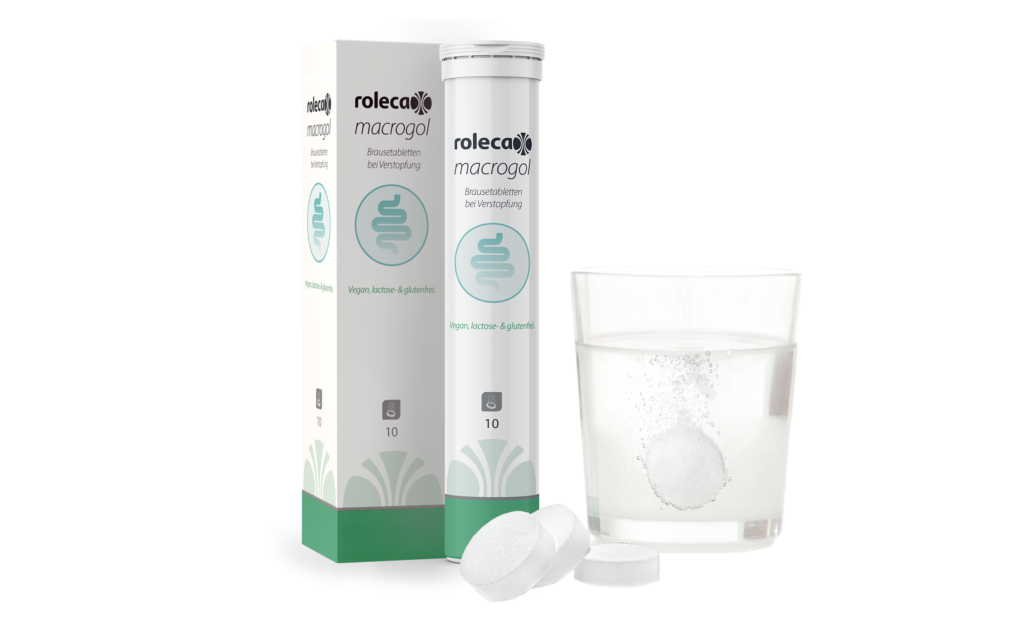
Effervescent tablets for constipation.
Gentle on the gut – effective in action.
References
- Bhatia, Vikram, and Rakesh K. Tandon. “Stress and the gastrointestinal tract.” Journal of gastroenterology and hepatology 20.3 (2005): 332-339
- Holland, Amy Marie, et al. “The enteric nervous system in gastrointestinal disease etiology.” Cellular and Molecular Life Sciences 78.10 (2021): 4713-4733
- Pinto-Sanchez, M.I., Hall, G.B., Ghajar, K., Nardelli, A., Bolino, C., Lau, J.T., Martin, F.-P., Cominetti, O., Welsh, C., Rieder, A., Traynor, J., Gregory, C., De Palma, G., Pigrau, M., Ford, A.C., Macri, J., Berger, B., Bergonzelli, G., Surette, M.G., Collins, S.M., Moayyedi, P., Bercik, P., 2017. Probiotic Bifidobacterium longum NCC3001 Reduces Depression Scores and Alters Brain Activity: A Pilot Study in Patients With Irritable Bowel Syndrome. Gastroenterology 153, 448-459.e8
- Lyseng-Williamson, K.A., 2018. Macrogol (polyethylene glycol) 4000 without electrolytes in the symptomatic treatment of chronic constipation: a profile of its use. Drugs Ther. Perspect. Ration. Drug Sel. Use 34, 300–310.
- Davis, G.R., Santa Ana, C.A., Morawski, S.G., Fordtran, J.S., 1980. Development of a lavage solution associated with minimal water and electrolyte absorption or secretion. Gastroenterology 78, 991–995.
- Fordtran, J.S., Santa Ana, C.A., Cleveland MvB, null, 1990. A low-sodium solution for gastrointestinal lavage. Gastroenterology 98, 11–16.
- Vetter, C., 1999. Macrogol bei Obstipation: Abführen ohne Elektrolytverlust. Dtsch. Ärztebl. 96.
- Schiffter-Weinle, H., 2015. PEG – das Multitalent. Dtsch. Apoth. Ztg. 26, 38
Learn more about the following topics

This post is also available in:
Kontakt

Roleca Pharma GmbH
Georgstraße 38
D-30159 Hannover
T: +49 511 5151 680
info@roleca.com
Melden Sie sich zu unserem Newsletter an, um auf dem Laufenden zu bleiben

